|
5
Elements of Cooperative Learning It is only under certain conditions that cooperative efforts may be expected to be more productive than competitive and individualistic efforts. Those conditions are:
|
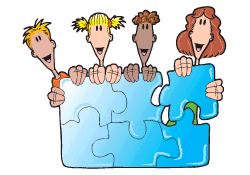
Working in a team
Sitting together is not enough to ensure teamwork. Small teams sit together and try to improve their understanding of a subject. Each member of a team is responsible not only for learning what is taught but also for helping teammates learn, thus creating an atmosphere of achievement. Students work through the assignment until all group members successfully understand and complete it.
Cooperative efforts result in participants striving for mutual benefit so that all group members:
· gain from each other's efforts. (Your success benefits me and my success benefits you.)
· recognize that all group members share a common fate. (We all sink or swim together here.)
· know that one's performance is mutually caused by oneself and one's team members. (We can not do it without you.)
· feel proud and jointly celebrate when a group member is recognized for achievement. (We all congratulate you on your accomplishment!).
|
5
Elements of Cooperative Learning It is only under certain conditions that cooperative efforts may be expected to be more productive than competitive and individualistic efforts. Those conditions are:
|
· While doing this web quest you are going to work as a team. It’s very important to divide the work load among yourselves. For instance pupil A is going to print out pictures. Pupil B and C are searching the website in order to form the answers and Pupil D is gathering colored paper and glue to use later when your are making the collage.
· Share your findings with each other and discuss each other’s findings in orderly manner without offending each other.
· If you need any help seek advice in your group.
· Click on the link to print out the self reflection form every time you finish working with the team and hand the forms in. Every member of the team has to fill it in! Cooperative self evaluation.
< HOME >
Webquests in the Dutch language? www.webkwestie.nl

|
Dit werk valt onder een Creative Commons licensie. www.webkwestie.nl is een gratis website voor alle onderwijssoorten. Er is geprobeerd alleen maar rechtenvrij (beeld)materiaal te gebruiken en/of (beeld)materiaal te gebruiken voor niet-commercieel gebruik. Mocht u desalniettemin materiaal zien waar auteursrecht op rust, laat het ons dan meteen weten. Er wordt z.s.m. op gehandeld. De afbeeldingen zijn afkomstig van Pixabay en PXhere, Commons.Wikimedia of Microsoft Clipart Gallery, tenzij anders is vermeld. |